yeni makale..
Beyan Edilen Boy ve Kilo Verilerinin Güvenilirliği ve Adli Açıdan Önemi
yeni makale..
yeni makale..

Let’s face it. Concurrency is a good thing when it comes to database applications. After all, if there is only a single user of your application, then chances are, it is not a successful application  . Of course there are exceptions to this rule, but by and large, most of the applications we build are going to be used by large populations of users. And given the recent publicity of users data and privacy, we can also be pretty confident that we want the data in our applications to be correct at all times.
As a developer, it is absolutely critical to keep concurrency in mind when building applications. Here is a simple demonstration to thrust home the point.
The task assigned to the developer here is simple – transfer move all of the rows satisfying a particular condition from table T1 to table T2. Let’s create our database objects…
View original post 1,144 more words
Sometimes in the IT world, the term “surprise” is not a good one.
“I woke up this morning and got a …my database was down.”
“I ran a SELECT COUNT(*) on my most important table, and got a result of zero rows.”
and so forth. Generally as IT professionals, encountering the unexpected is not a good start to the day  .
.
But sometimes, surprises can be a nice thing. Here is my example for today – when I found that the database can do a remarkably good job when it comes to reducing the workload with partitioned tables.
Most people will already be familiar with the concept of partition elimination. If you have a table partitioned into (say) yearly segments, and you ask for all of the data for the past 2 years, then the optimizer is intelligent enough to only scan the relevant partitions rather than the entire…
View original post 698 more words
His blog is a gem :)
Sometimes you want to add a little more color to the navigation menu. The idea in one project was to use colors for certain areas in an application. The color would show the user where he is currently working. Whether such colors are a feature that end users like, is still part of an ongoing discussion. But here are the technical details how to implement it.
The example uses a very small apex application that I’ll be using for a DOAG2015 presentation “Exotic SQL” (http://syntegris-doag.de/#vortraege).
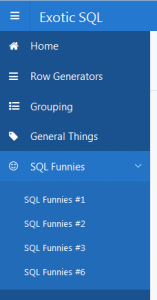
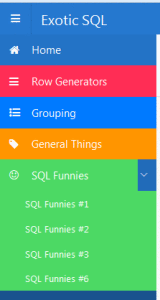
I explain the changes in detail a little further down.
Special Features:
View original post 902 more words
svenweller!
I can not guarantee that you never heared of this. But the majority of developers doesn’t know or doesn’t seem to know. And honestly – most of this information is fairly useless – and mostly harmless.
There is a concat function that can be used instead of the concat operator ||.
Nobody uses that! But there is a reason why it exists.
This is from the 8.1.7 Oracle documention
On most platforms, the concatenation operator is two solid vertical bars, as shown in Table 3-3. However, some IBM platforms use broken vertical bars for this operator. When moving SQL script files between systems having different character sets, such as between ASCII and EBCDIC, vertical bars might not be translated into the vertical bar required by the target Oracle environment. Oracle provides the
CONCATcharacter function…
View original post 2,420 more words
I’ve had quite a few discussions with people regarding whether APEX running inside the database is a good thing or a bad thing. Personally I believe it is definitely a good thing, I see no downsides really. However a recent forum thread
For me, the fact that APEX runs inside the database means that one of the major positives is you are able to take full advantage of each and every database available to you. A recent forum thread illustrates this very nicely. The poster in the thread has deleted some files and has unfortunately performed a commit before realising their mistake.
Here is where the features of the database can help you, for example we are able to take advantage of the Flashback feature to get the database back to the state it was in before the files were deleted.
The user in the forum deleted some files from…
View original post 838 more words
Ever had a trouble while you were trying to print a variable, got an ORA-06502 error?
ORA-06502: PL/SQL: numeric or value error string
Cause: An arithmetic, numeric, string, conversion, or constraint error occurred. For example, this error occurs if an attempt is made to assign the value NULL to a variable declared NOT NULL, or if an attempt is made to assign an integer larger than 99 to a variable declared NUMBER(2).
Action: Change the data, how it is manipulated, or how it is declared so that values do not violate constraints.
Here is what I came across to. A big and special thanks to oracle forums, of course :)
PROCEDURE chunk_clob(p_clob CLOB) IS

v_buf_size	VARCHAR2(32000);

v_offset	PLS_INTEGER DEFAULT 1;

v_size    	PLS_INTEGER;

v_len		PLS_INTEGER;

v_chunk		PLS_INTEGER;

v_clob		CLOB := p_clob;

BEGIN

v_chunk		:= dbms_lob.getchunksize(v_clob);

v_len		:= dbms_lob.getlength(v_clob);

WHILE v_offset  v_chunk

THEN	v_size := v_chunk;

ELSE	v_size := v_len - (v_offset - 1);

END IF;

v_buf_size	:= NULL;

dbms_lob.READ(v_clob, v_size, v_offset, v_buf_size);

htp.prn(v_buf_size);

v_offset := v_offset + v_size;

END LOOP;

END;
– OKAY what is this and what am I going to do with this?
It ‘ll take care of your oversized strings so you get to see what your VAR has in it.
my_pck.chunk_clob(l_show_html);




 simple.